

Journey of My Portfolio: WordPress Era

During the second year of university, we were assigned a module project to build our own portfolio website.
And for me, this was a massive deal. Because this wasn’t just another experimental blog anymore. This was supposed to be my professional website.
The internet was about to witness peak student developer energy.
Buying brionmario.com for 99 Cents
This was around the golden era of absurd domain promotions. I somehow managed to grab brionmario.com for 99 cents for the first year. At the time, this felt like the greatest business deal in human history. I genuinely remember thinking:
“Wow. I officially own part of the internet now.”
Of course, nobody tells you what happens after the first year renewal pricing kicks in 😂
But at that moment, having my own .com domain felt incredibly exciting. It made everything feel real.
Discovering WordPress
Unlike Blogspot, WordPress felt powerful. Suddenly I wasn’t just editing widgets anymore.
Now I was dealing with, hosting providers, cPanel dashboards, databases, plugins, themes, PHP files, FTP clients, and mysterious errors that appeared out of nowhere.
This was my first real exposure to how websites actually worked behind the scenes. And honestly, it was chaotic. The setup process alone felt like engineering.
The “Professional Portfolio” Era
Naturally, the first thing I did was download a WordPress portfolio template. Because obviously, writing one from scratch was not happening due to the tight deadline.
Back then, downloading themes from random websites and modifying them until they barely resembled the original template was basically frontend engineering.
The portfolio itself mostly revolved around the technologies I was exploring during university:
- Microsoft Azure
- Android development
- Mobile apps
- and random side projects that probably only worked on my machine
Accidentally Learning PHP
One of the funniest things about WordPress was that it slowly forced you into programming whether you planned for it or not.
You’d start by trying to, change a button and suddenly you’re inside a massive PHP file trying to understand what <?php even means.
That’s how I slowly started becoming comfortable with reading code. Not through tutorials. Not through courses. But through curiosity, trial and error, Stack Overflow, and repeatedly breaking my own website.
Shared Hosting Survival Skills
This was also the phase where I accidentally learned hosting. After buying brionmario.com for 99 cents, I also bought a shared hosting package from HostGator using one of those “massive first-year discount” offers.
At the time, as a broke university student, that was a very bad call. But in my head, this was an investment. I was building my future empire on the internet 😂
Which meant learning things the hard way:
- uploading files through FileZilla
- fixing broken permissions
- editing databases through phpMyAdmin
- fighting with DNS propagation
- configuring email accounts I never used
At the time, it felt frustrating. Looking back now, those experiences were incredibly valuable. Because unlike modern managed platforms like Vercel and one-click deployments, shared hosting exposed you to the messy parts of the web very early.
Looking Back
In fact, all I have left of that monstrosity now is a screenshot I recovered from the Wayback Machine.
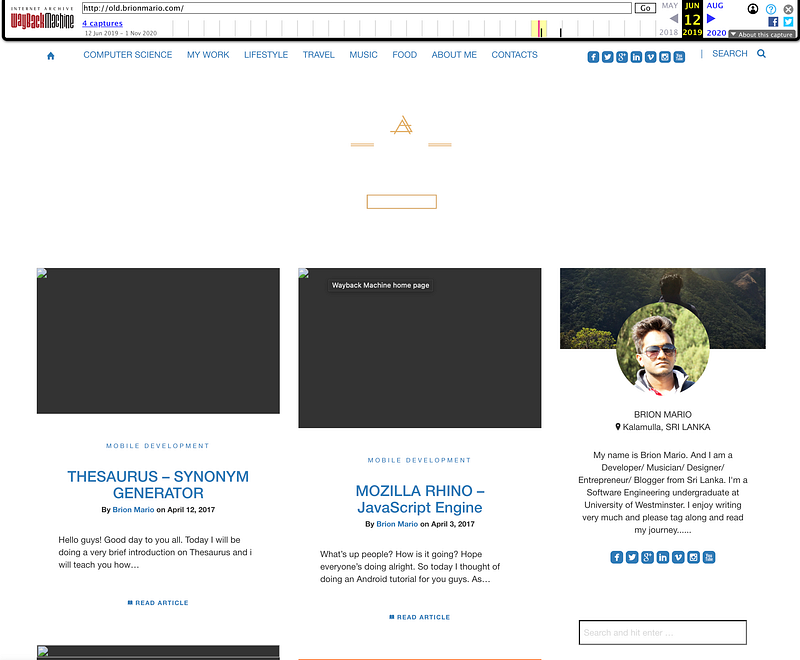
Objectively speaking, it was probably overdesigned, overloaded with plugins, and running dangerously close to complete failure at all times. But it represented something important. That project introduced me to an entirely new side of the web beyond just “making pages look nice.”
For the first time, I started understanding domains, DNS, hosting, databases, deployments, email configurations, and how websites actually existed on the internet.
Up until then, websites felt abstract.
Now I was configuring them myself, breaking them myself, and somehow fixing them myself. And surprisingly, that portfolio even helped me land a few freelance website projects during university. Mostly small business or personal websites. Nothing revolutionary. But for a university student, getting paid to build websites felt incredible.
Blogspot taught me curiosity. WordPress taught me systems, debugging, customization, hosting, and problem solving.
And without realizing it at the time, I was slowly moving from:
“someone interested in technology”
to:
“someone becoming an engineer.”
To be continued….